

When you run Oracle E-Business Suite Payroll in South Africa, you are not only calculating salaries. You are processing identity numbers, banking details, tax information, employment records, medical-aid deductions, pension contributions, garnishee orders and other highly confidential employee information.
A payroll environment must therefore do more than complete the monthly pay run. It must remain accurate, secure, available, auditable and aligned with South African legislation.
It also raises an important strategic question:
Where is your payroll data physically stored, backed up, replicated and accessed?
For South African organisations, hosting Oracle EBS Payroll locally can provide greater control over data sovereignty, regulatory risk, operational resilience and disaster recovery.
Oracle EBS Payroll must remain legislatively current
South African payroll requirements change regularly following the National Budget Speech, tax amendments and updates issued by the South African Revenue Service.
Oracle provides South African legislative functionality within Oracle HRMS and releases applicable legislative patches for supported Oracle EBS environments. However, simply running Oracle Payroll does not automatically guarantee compliance.
Every organisation remains responsible for ensuring that its system is correctly configured, patched, tested and reconciled.
Important payroll compliance areas include:
- PAYE calculations and deductions
- Unemployment Insurance Fund contributions
- Skills Development Levy calculations
- Retirement fund and medical-aid deductions
- Taxable benefits and allowances
- Fringe-benefit calculations
- Employment Tax Incentive processing, where applicable
- IRP5 and IT3(a) tax certificates
- EMP201 monthly declarations
- EMP501 interim and annual reconciliations
- SARS Business Requirement Specification changes
- Tax-year-end and tax-year-start processing
SARS requires employers to reconcile their EMP201 declarations, payments and employee tax certificates through the EMP501 process. Incorrect calculations, incomplete information or late submissions may expose the employer to penalties and interest.
Oracle’s South African HRMS functionality includes country-specific implementation and processing requirements. These must be maintained alongside the organisation’s global Oracle HRMS configuration. Oracle’s South Africa HRMS documentation provides the relevant legislative-specific implementation guidance.
Legislative patching cannot be left until year-end
One of the most common payroll risks is delaying Oracle legislative patches until shortly before the annual EMP501 submission.
A safer approach is to manage legislative changes as a controlled business process:
- Monitor Oracle and SARS announcements throughout the year.
- Confirm that the Oracle EBS release and database platform remain supported.
- Review each South African legislative patch and its prerequisites.
- Apply the patch in a non-production environment first.
- Test representative employee groups and payroll scenarios.
- Compare results before and after patching.
- Obtain formal approval from payroll, finance, tax and IT.
- Move the verified changes into production under change control.
- Retain the patching, testing and approval evidence for audit purposes.
Testing should include employees with different tax statuses, allowances, bonuses, benefits, deductions, retirement contributions and retrospective adjustments. Interfaces to banking platforms, time-and-attendance systems, general ledger and SARS reporting tools must also be validated.
A patch may install successfully from a technical perspective but still produce an unexpected business outcome. Payroll testing must therefore be performed jointly by Oracle technical specialists and experienced South African payroll users.
POPIA and employee payroll information
Payroll data is personal information and may also include information requiring particularly careful handling. Under the Protection of Personal Information Act, organisations must process personal information lawfully, for a defined purpose, with appropriate security safeguards and proper accountability.
A compliant Oracle EBS Payroll environment should support:
- Clearly defined ownership of employee information
- Role-based access to payroll responsibilities and functions
- Segregation of duties between payroll, HR, finance and IT
- Strong authentication and privileged-access controls
- Encryption of data in transit and, where appropriate, at rest
- Monitoring of payroll and database administrator activity
- Controlled extraction and distribution of payroll reports
- Secure management of interfaces and integration accounts
- Formal retention and deletion requirements
- Documented incident and breach-response procedures
- Written operator agreements with service providers
- Regular access reviews and security assessments
POPIA does not impose a universal rule stating that all payroll information must remain inside South Africa. However, section 72 places conditions on transferring personal information to a recipient in another country. Appropriate protection, agreements, consent or another permitted basis must exist before such a transfer takes place. The official Protection of Personal Information Act sets out these requirements.
Keeping payroll data in South Africa can significantly simplify the organisation’s governance model. It reduces unnecessary cross-border exposure and gives the organisation clearer control over where its production data, backups, standby databases and support copies are located.
Local hosting should therefore be viewed as a strong data-sovereignty and risk-management decision—not as a substitute for a complete POPIA compliance programme.
Do you know where every copy of your payroll data is stored?
The location of the production database is only part of the discussion.
Organisations must also establish where the following are stored:
- RMAN database backups
- Disaster-recovery databases
- Application-tier backups
- Database exports and Data Pump files
- Payroll extracts and bank files
- IRP5 and EMP501 files
- Test and development database copies
- Archived payslips and payroll reports
- Monitoring and diagnostic information
- Support bundles uploaded to third parties
- Files stored on shared drives or collaboration platforms
An organisation may believe its payroll system is hosted locally while backups, non-production clones or support extracts are being transferred outside South Africa.
A complete data-location assessment must follow the entire payroll-data lifecycle—from initial capture and monthly processing to reporting, backup, recovery, archiving and eventual deletion.
Why local hosting matters
Hosting Oracle EBS Payroll within South Africa can deliver important business benefits.
- Stronger data sovereignty
The organisation has clearer visibility into the physical location of its systems, databases, backups and disaster-recovery copies.
- Reduced cross-border complexity
Local hosting can reduce the number of international transfers, overseas operators and foreign legal environments that must be evaluated and governed.
- Improved performance
Locally hosted systems can provide lower network latency for South African employees, payroll teams and integrated business systems.
- Faster local support
South African Oracle EBS, database, infrastructure and payroll specialists can respond within the same time zone and understand local legislative deadlines.
- Greater operational resilience
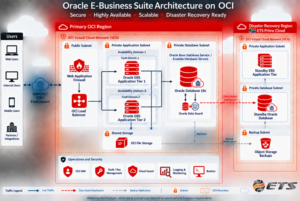
Production and disaster recovery can be hosted in separate South African data centres, providing geographic resilience while retaining in-country control.
- Clearer audit evidence
Local hosting can make it easier to demonstrate data location, access controls, backup arrangements, recovery capability and service-provider accountability.
Security must cover the entire Oracle EBS stack
Payroll security cannot be achieved through application responsibilities alone.
An Oracle EBS Payroll environment normally includes several interconnected layers:
- Oracle E-Business Suite application services
- Oracle Database
- Oracle WebLogic and application-tier services
- Oracle Linux or another supported operating system
- Load balancers and network controls
- Identity and access-management services
- Backup and recovery infrastructure
- Monitoring and alerting platforms
- Interfaces to banks, SARS, finance and HR systems
- Disaster-recovery infrastructure
Each layer must be secured, patched, monitored and included in the organisation’s recovery plan.
Security reviews should cover excessive Oracle responsibilities, direct database access, shared accounts, dormant users, privileged operating-system access, integration credentials, payroll report distribution and unprotected non-production environments.
Test and development databases deserve particular attention. A cloned payroll database contains the same sensitive employee information as production unless it has been properly masked or otherwise protected.
Disaster recovery is a payroll compliance issue
Employees expect to be paid accurately and on time, even when infrastructure fails.
A compliant payroll service therefore needs a tested business-continuity and disaster-recovery capability. Backups alone are not enough. The organisation must know whether it can restore the full Oracle EBS service within the time required by the payroll calendar.
A strong recovery design should include:
- A documented recovery-time objective
- A documented recovery-point objective
- A separate disaster-recovery location
- Database replication or recoverable backups
- Application-tier recovery procedures
- Secure off-site backup copies
- Regular restore testing
- Scheduled disaster-recovery exercises
- Validated network and integration dependencies
- Clear business and technical escalation procedures
- Payroll contingency procedures for critical processing dates
Recovery tests should prove that the application can be accessed, payroll processes can run, reports can be generated and critical interfaces can operate. A database that has opened successfully is not necessarily a fully recovered payroll service.
A practical Oracle EBS Payroll compliance checklist
South African organisations should be able to answer “yes” to the following questions:
- Is our Oracle EBS release supported and appropriately patched?
- Have the latest applicable South African legislative updates been assessed?
- Are legislative patches tested before production deployment?
- Do our EMP201, EMP501 and IRP5 values reconcile?
- Are payroll changes formally reviewed and approved?
- Are payroll responsibilities restricted according to job function?
- Are privileged and administrator activities monitored?
- Are payroll interfaces encrypted and controlled?
- Do we know where production, backup, DR and test data are stored?
- Have all cross-border transfers been identified and evaluated?
- Are third-party operator responsibilities contractually defined?
- Are non-production payroll databases protected or masked?
- Can we restore the complete EBS Payroll service within the required timeframe?
- Has disaster recovery been tested against a real payroll scenario?
- Do we retain sufficient evidence for internal and external audits?
If any of these answers is unclear, the organisation has a control gap that should be addressed before the next payroll, tax-year-end or audit cycle.
Keep South African payroll secure, local and resilient
Oracle E-Business Suite remains a powerful platform for processing complex South African payrolls. Its success, however, depends on much more than payroll configuration.
Organisations need a coordinated approach covering:
- South African legislative compliance
- Oracle patch and release management
- SARS reconciliation
- POPIA-aligned data protection
- In-country data hosting
- Database and application security
- Backup and disaster recovery
- Monitoring and operational support
- Regular compliance and health assessments
Oracle help organisations assess, secure, patch, host, monitor and support Oracle E-Business Suite environments across the complete technology stack.
Through ETS PrimeCloud, South African organisations can host critical Oracle workloads locally and design in-country production and disaster-recovery services aligned with their security, availability and data-sovereignty objectives.
Your payroll does not only need to run.
It must run accurately, securely, compliantly and reliably—every pay cycle.
Is your Oracle EBS Payroll environment ready for its next legislative update, EMP501 reconciliation, security audit or disaster-recovery test?
Contact Ahmed Jassat to arrange an Oracle EBS Payroll, security, compliance and data-location assessment.
Secure. Local. Resilient.