

Oracle Autonomous Linux: The Future of Autonomous Operating Systems
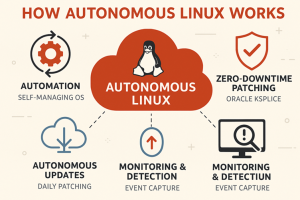
In today’s fast-paced digital world, businesses demand agility, security, and efficiency from their IT infrastructure. Oracle Autonomous Linux delivers exactly that—a self-managing, self-patching, and self-tuning operating system designed to reduce complexity and human error while improving security and availability.
What is Oracle Autonomous Linux?
Oracle Autonomous Linux is the world’s first autonomous operating environment, running on Oracle Cloud Infrastructure (OCI). It automates routine OS management tasks such as patching, updates, and monitoring, freeing IT teams to focus on strategic initiatives rather than maintenance. It is fully binary-compatible with Red Hat Enterprise Linux, ensuring seamless migration for existing workloads.
Key Features
- Zero-Downtime Patching
Using Oracle Ksplice, Autonomous Linux applies kernel and critical library updates without rebooting, ensuring maximum uptime. - Daily Autonomous Updates
Automatic patching for kernel, OpenSSL, and glibc libraries keeps systems secure and compliant without manual intervention. - Event Monitoring & Exploit Detection
Built-in monitoring captures critical events like kernel crashes and detects exploit attempts, notifying administrators in real time. - Performance Optimization
Powered by the Unbreakable Enterprise Kernel, it delivers enterprise-grade performance for demanding workloads. - Integrated Security
Autonomous Linux continuously applies security patches and leverages AI-driven automation to minimize vulnerabilities.
Benefits for Enterprises
- Enhanced Security & Compliance
Systems remain patched and secure automatically, reducing risk and meeting compliance requirements. - Lower Operational Costs
Eliminates manual patching and monitoring, reducing administrative overhead and freeing resources for innovation. - High Availability
Zero-downtime updates ensure uninterrupted operations for mission-critical applications. - Rapid Deployment
Autonomous Linux instances can be deployed in minutes via OCI Console, making it ideal for dynamic cloud environments.
Use Cases
- Cloud-Native Applications: Ideal for OCI workloads requiring high security and performance.
- Enterprise Migration: Seamless transition for organizations moving from RHEL or CentOS.
- Regulated Industries: Automated compliance and security patching for finance, healthcare, and government sectors.
Why It Matters
Adding autonomous capabilities at the operating system layer directly addresses one of the biggest and most persistent challenges enterprises face today—managing operational complexity while maintaining strong security across rapidly growing environments. Traditional Linux administration requires continuous human involvement for patching, tuning, monitoring, troubleshooting, and hardening. As systems scale or become more distributed across cloud and on-premises platforms, these tasks often become overwhelming, leading to delays, inconsistency, and increased exposure to risk.
Oracle Autonomous Linux changes this dynamic entirely. By intelligently automating routine operational tasks, the platform eliminates large portions of manual effort that typically consume valuable IT time. It automatically applies patches and security updates—often within hours of release—without requiring downtime or administrator intervention. This alone provides a massive security advantage, ensuring systems remain protected against vulnerabilities that attackers often exploit long before traditional patch cycles are completed.
Beyond security, Autonomous Linux automates performance tuning, resource optimization, and health monitoring. The system constantly evaluates itself, making adjustments to ensure stability and efficiency, and raising alerts only when human attention is genuinely required. This continuous optimization helps maintain predictable performance even during peak workloads.
For IT teams, the benefits are significant. Instead of spending countless hours on repetitive system maintenance, administrators can shift their effort toward high-value initiatives such as solution architecture, application modernization, cloud migration, and innovation projects that directly impact business outcomes. In fast-moving digital environments, this reallocation of skills and time becomes a powerful competitive advantage.
Ultimately, Oracle Autonomous Linux empowers organizations to operate with greater efficiency, reduced risk, and higher agility. By embedding intelligence directly into the OS layer, it creates a secure, self-managing foundation that supports modern workloads and enables IT teams to contribute more strategically to overall business growth.
Contact ahmed.jassat@ets.group, Africa’s Oracle ACE Pro, for for expert guidance on upgrading or migrating to Oracle Autonomous Linux.