

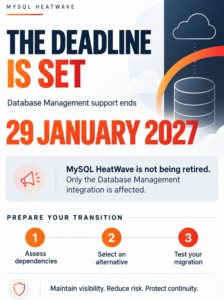
Oracle announced that Database Management for MySQL HeatWave within Oracle Cloud Infrastructure (OCI) has been deprecated and will remain available until 29 January 2027. Organizations currently relying on Database Management to monitor and manage their MySQL HeatWave environments should begin evaluating alternative monitoring and management solutions to ensure a smooth transition before the service reaches its end-of-life date.
Why This Matters
For many organizations, Oracle Database Management has provided a centralized platform for monitoring MySQL HeatWave performance, availability, diagnostics, and operational health. The announcement means that while existing services will continue to function until January 2027, businesses should proactively plan their future monitoring strategy rather than waiting until the final deadline.
As database professionals, we know that monitoring is not just about dashboards. It is fundamental to:
- Performance optimization
- Capacity planning
- Availability management
- Security monitoring
- Incident response
- Root cause analysis
A well-planned migration strategy will help avoid operational disruptions when the service is retired.
What Oracle Has Announced
According to Oracle’s release notes:
- Database Management support for MySQL HeatWave has been deprecated.
- Existing enabled resources will remain operational until 29 January 2027.
- Customers should adopt an alternative monitoring solution before the retirement date.
- HeatWave database services themselves are not being retired; only the Database Management integration is affected.
This distinction is important. Organizations can continue using MySQL HeatWave, but they must determine how they will monitor and manage those environments going forward.
Key Considerations for Existing Customers
- Review Current Dependencies
Many operational teams rely on Database Management for:
- Performance metrics
- SQL monitoring
- Database diagnostics
- Alerting and notifications
- Operational dashboards
Understanding which business processes depend on these capabilities is the first step in planning a migration path.
- Evaluate Alternative Observability Platforms
Organizations should assess alternative monitoring tools that align with their operational requirements and cloud strategy.
Areas to evaluate include:
- Database performance monitoring
- Infrastructure monitoring
- Log analytics
- Alerting capabilities
- Integration with Service Management platforms
- Reporting and compliance requirements
The goal should be to maintain or improve visibility while reducing operational risk.
- Avoid Last-Minute Migration Efforts
Experience shows that waiting until a service reaches end-of-life often results in:
- Increased project risk
- Compressed testing windows
- Unplanned downtime
- Resource constraints
Starting the assessment process now provides sufficient time for architecture reviews, proof-of-concepts, testing, and operational readiness.
A DBA Perspective
As database administrators, we frequently focus on availability, backups, performance tuning, and security. However, monitoring platforms are equally critical components of the database ecosystem.
A database without effective monitoring is similar to driving a vehicle without dashboard indicators. You may continue operating, but your ability to proactively detect issues becomes significantly reduced.
This announcement presents a good opportunity for IT teams to:
- Reassess monitoring standards
- Modernize observability capabilities
- Improve automation
- Align monitoring with enterprise cloud strategies
Instead of viewing this purely as a retirement notice, organizations can leverage it as an opportunity to strengthen operational excellence.
Recommended Next Steps
 Review all MySQL HeatWave environments currently using Database Management.
Document monitoring, alerting, and reporting requirements.
Identify alternative monitoring solutions.
Perform proof-of-concept testing.
Develop a migration roadmap well before January 2027.
Train operational and support teams on the new platform.
Final Thoughts
Oracle’s announcement gives customers approximately one year to transition away from Database Management for MySQL HeatWave. While this is a significant change, the timeline provides ample opportunity to evaluate alternatives, improve observability practices, and ensure operational continuity.
For organizations running mission-critical MySQL HeatWave workloads, now is the right time to start planning. The most successful migrations are never rushed, they are carefully designed, tested, and executed with the future in mind.
What monitoring and observability platforms are you considering for MySQL HeatWave environments after 2027? I’d be interested to hear how other database and cloud teams are approaching this transition.
Join us at the SAOUG Conference 2026 to learn more.