
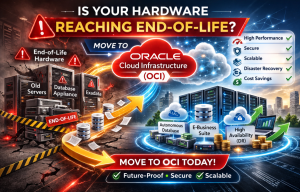
Across Africa and globally, many organisations are quietly approaching a critical technology crossroads.
Infrastructure that once powered innovation — your trusted servers, Oracle Database Appliances, Exadata platforms, and legacy data centre investments — are now reaching End-of-Life (EOL) or End-of-Support (EOS).
At first glance, it may seem like a routine IT refresh cycle. Replace hardware, renew support, and continue business as usual.
But in reality, this moment represents something far greater.
It is an opportunity to transform your organisation’s digital future.
The Hidden Cost of Staying on Aging Infrastructure
In my experience working with organisations across banking, manufacturing, aviation, retail, and public sector environments, aging infrastructure rarely fails overnight. Instead, it slowly introduces operational friction.
Performance begins to plateau. Maintenance costs increase year after year. Vendor support becomes more limited. Security risks grow. Disaster recovery becomes harder to test and maintain.
Most importantly, your ability to innovate, scale, and respond to business demand becomes constrained.
The business wants analytics, AI, mobile integrations, and real-time insights — but the underlying infrastructure is holding everything back.
This is the real cost of doing nothing.
Why Leading Organisations Are Moving to Oracle Cloud Infrastructure (OCI)
Forward-thinking organisations are not simply replacing hardware anymore. They are rethinking their entire platform strategy.
Oracle Cloud Infrastructure (OCI) is purpose-built for enterprise workloads, especially Oracle databases and applications such as Oracle E-Business Suite.
What makes OCI different is that it is not just “another cloud.” It is a high-performance, secure, enterprise-grade platform designed by Oracle for Oracle workloads.
When organisations move to OCI, they immediately unlock:
- A modern, high-performance platform capable of handling mission-critical workloads with ease.
- A secure environment built on zero-trust principles, encryption, and identity-driven access.
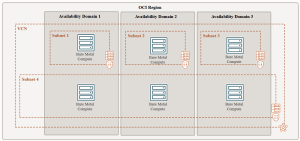
Built-in high availability and disaster recovery across availability domains and regions. - The flexibility to scale resources as the business grows, without large capital investments.
- A significantly lower total cost of ownership when compared to ongoing hardware refresh cycles.
Most importantly, they gain the freedom to focus on business innovation instead of infrastructure maintenance.
From On-Premise to Cloud: A Journey We Walk with Our Clients
At ETS Innovations, we have guided many organisations through this transition — from traditional on-premise environments into modern OCI platforms.
These environments range from Oracle Database Appliance (ODA) platforms and legacy virtualised estates, to complex multi-node Oracle E-Business Suite environments with integrated disaster recovery.
Each journey is unique, but the approach is always structured, controlled, and business-aligned.
We begin with a deep assessment of the current environment — understanding performance, dependencies, licensing, and risk. From there, we design a secure and scalable OCI landing zone tailored to the organisation’s needs, including networking, identity, and disaster recovery architecture.
The migration itself is executed using proven Oracle technologies such as RMAN, Data Pump, or GoldenGate, ensuring minimal disruption to business operations. Once workloads are migrated, we optimise performance, strengthen security, and support the business through go-live and hypercare.
This is not just a technical migration. It is a business transformation journey.
The Results We Are Seeing
When organisations make the move to Oracle Cloud Infrastructure, the results are tangible.
- Systems become faster and more stable.
- Operational costs reduce.
- Security posture improves significantly.
- Disaster recovery becomes simpler and more reliable.
And most importantly, IT teams are empowered to deliver innovation to the business.
Instead of spending time maintaining aging hardware, teams can focus on enabling growth, analytics, automation, and digital services.
A Simple Question for Every CIO and IT Leader
If your hardware were to reach end-of-support tomorrow, what would your plan be?
Would you invest again in another hardware refresh cycle… or would you use this moment to modernise your platform and position your organisation for the next decade?
The organisations that act now are the ones that will lead in the future.
Let’s Future-Proof Your Environment
If your infrastructure is approaching end-of-life, this is the ideal time to explore your options and define a roadmap to Oracle Cloud Infrastructure. Contact ahmed.jassat@ets.group, Africa’s Oracle ACE Pro, for more information.